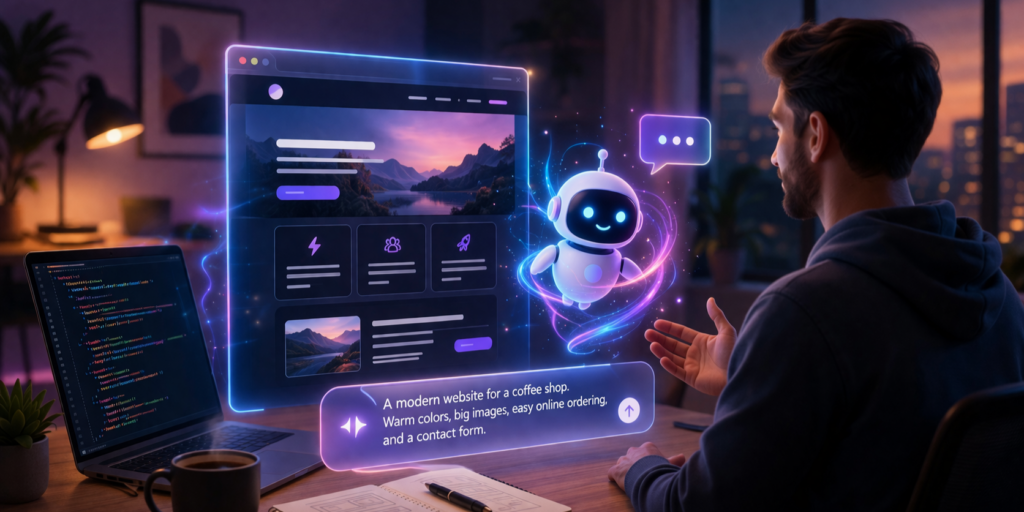

If you are a small business owner who has ever been told that building a professional website costs $5,000 and takes two months, or if you have tried to build one yourself and given up halfway through a drag-and-drop interface at midnight — this post is for you. AI website builders for small business are fundamentally changing who gets to have a professional online presence, how quickly, and at what cost.
But the space is also crowded with hype. Not every AI builder delivers what it promises, not every small business needs the same thing, and “AI” has become a marketing prefix attached to tools of wildly varying quality and capability. This guide gives you the full, honest picture: what AI web building actually means, why it represents a genuine shift for small businesses, what its real limitations are, how it interacts with SEO, and what to look for when choosing a platform.
- AI Web Building.
- What Is an AI Website Builder?
- Why This Matters for Small Businesses Right Now
- How AI Web Building Actually Works
- You describe your business in natural language
- The AI processes intent and generates a site architecture
- Copy, layout, and imagery are generated automatically
- The site is built on a CMS and deployed to hosting
- You refine through conversation or visual editing
- The Real Benefits for Small Business Owners
- Honest Limitations of AI Website Builders
- AI Builders and SEO: What Small Businesses Should Realistically Expect
- AI Website Builders Worth Knowing in 2025
- How to Choose the Right AI Website Builder for Your Small Business
What Is an AI Website Builder?
Context: Google SEO Starter Guide · About WordPress
An AI website builder is a software platform that uses artificial intelligence — primarily natural language processing (NLP) and machine learning — to automate or dramatically simplify the process of creating a website. Instead of dragging and dropping elements onto a canvas, writing code, or choosing from a library of templates, the user describes what they need — in plain language — and the AI generates a site from that description.
The most advanced AI website builders for small business go well beyond a design shortcut. They generate page copy, suggest site structure, configure navigation, set up forms and booking systems, optimise images, and in some cases deploy the site to hosting automatically. The net result is that a task that historically required a web designer, a copywriter, and several weeks can be compressed into a single conversation that produces a functional, professional website in hours — sometimes minutes.
It is important to distinguish between different levels of “AI” in the website builder market:
| Type | What “AI” actually means | Example |
|---|---|---|
| AI-assisted builders | Traditional drag-and-drop builder with AI features bolted on — content suggestions, image generation, basic copywriting help | Wix ADI, Squarespace AI |
| Conversational AI builders | Chat-based interface where the user describes their business and the AI generates the full site structure, content, and design from that prompt | Durable, Hostinger AI, Abantu AI Builder |
| Agentic AI builders | AI takes autonomous actions across multiple steps — building, deploying, hosting, and iterating on the site — with minimal user input required | Abantu AI Web Builder, emerging platforms |
The distinction matters because the capabilities, quality of output, and degree of control vary significantly across these tiers. Most platforms marketed as “AI builders” today fall into the first category — traditional builders with AI writing features. True conversational and agentic AI builders, which generate a complete, deployable website from a natural language description, represent the leading edge of where the technology is heading.
Why This Matters for Small Businesses Right Now
Data: Network Solutions: Small Business Website Statistics · Marketing LTB: Small Business Website Statistics 2025
The website gap in the small business world is not a technology problem — it has always been a cost and complexity problem. Professional agency-built websites for small businesses have historically ranged from $2,000 to $9,000 for a basic site, with annual maintenance costs of $500–$1,200 on top. For a sole trader, a trades business, or a local service provider operating on thin margins, that has simply been out of reach.
The consequences of that gap are measurable. Nearly one in three U.S. shoppers reports deciding against visiting a small business specifically because it lacked a website. In a world where 81% of consumers research online before making a purchase, a business without a website is invisible to the majority of its potential customers before first contact.
2X
Small businesses with websites grow roughly twice as fast as those without, according to Marketing LTB’s analysis of small business digital adoption data — making a website one of the highest-leverage investments available to any small business owner.
The AI website builder for small business addresses this directly. Where the traditional path required either a large budget or technical skills most small business owners do not have, AI builders require neither. The cost has dropped to a monthly subscription in the range of $15–$170 depending on the platform and tier. The time from “I need a website” to “my website is live” has dropped from weeks to hours. And the technical skill required has dropped, for many platforms, to the ability to describe your business in plain sentences.
This is not a minor convenience improvement. For the estimated 27% of small businesses that currently have no web presence, AI website builders represent a genuine access revolution — a way onto the internet that did not previously exist at a price point they could afford.
How AI Web Building Actually Works
Reference: Large Language Models — Wikipedia · GPT-4 Technical Report
Understanding what is happening under the hood helps you evaluate platforms realistically and set the right expectations before you start. Here is how the most advanced AI website builders for small business work, step by step:
The CMS foundation matters enormously: AI builders that produce a site on WordPress give you a site you fully own, can migrate, and can build on indefinitely with thousands of plugins. AI builders that produce proprietary sites lock you into a single platform. Before choosing a tool, ask: “Who owns the site this produces, and can I take it elsewhere?”
The CMS foundation matters enormously: AI builders that produce a site on WordPress give you a site you fully own, can migrate, and can build on indefinitely with thousands of plugins. AI builders that produce proprietary sites lock you into a single platform. Before choosing a tool, ask: “Who owns the site this produces, and can I take it elsewhere?”
The Real Benefits for Small Business Owners
Data: AI Website Builder Statistics 2025 · Market.us: AI Website Builder Market Report
Beyond the headline promise of “build a website in minutes,” AI website builders for small businesses deliver a specific set of advantages that address the real obstacles most small business owners face when trying to establish an online presence.
Honest Limitations of AI Website Builders
Reference: Google: Helpful Content guidance
Any honest evaluation of AI website builders for small business has to include the limitations — and there are real ones. Understanding these upfront protects you from disappointment and helps you decide whether an AI builder is the right tool for your specific situation.
- AI-generated copy is a first draft, not a final product. The content a builder produces will be plausible and structurally correct, but it will not reflect your actual business story, your specific differentiators, your real client results, or your brand voice. Every page of AI-generated copy should be reviewed, personalised, and fact-checked before going live. Google’s helpful content guidance rewards original, experience-based content — generic AI copy published unedited will not perform well in search.
- Design customisation has limits. AI builders produce competent, conventional designs — clean, functional, mobile-responsive. They rarely produce distinctive, brand-defining design that sets a business apart visually. If your visual identity is a competitive advantage, the output of an AI builder may feel too generic. This is where a professional web designer still adds value that automation cannot replicate.
- Complex functionality requires more than AI. Advanced features — custom booking systems, complex membership sites, bespoke e-commerce logic, API integrations with industry-specific software — typically require either a developer or significant time in the platform’s settings. AI builders are excellent for standard small business sites; they are not the right tool for complex web applications.
- Platform lock-in is a real risk on some tools. AI builders that produce proprietary sites — meaning the site can only exist within their platform — leave you with no migration path if the platform changes its pricing, shuts down, or no longer meets your needs. Always choose a builder that produces a site you own on an open platform like WordPress.
- SEO foundations require human attention. While most AI builders handle basic technical SEO automatically, the content quality, keyword strategy, internal linking, and ongoing optimisation that produce real search rankings are not automated. A site launched with an AI builder is a starting point for SEO, not a shortcut past it.
Do not publish AI copy unedited: Google’s algorithms are increasingly adept at identifying generic, low-value content. AI-generated copy that closely resembles thousands of similar websites will not rank — and may actively suppress your site’s performance. Use the AI output as scaffolding, then replace it with your own words, your own story, and your own expertise.
AI Builders and SEO: What Small Businesses Should Realistically Expect
Resources: Google Search Console · LocalBusiness structured data · Core Web Vitals
The relationship between AI website builders and SEO is nuanced. AI builders are excellent at delivering the technical SEO foundation that used to require developer knowledge. They are not a substitute for the ongoing content strategy, keyword targeting, and authority-building that produces real organic rankings. Understanding this distinction prevents both over-expectation and under-use.
The honest truth about AI builders and SEO: An AI website builder gives you a technically sound, indexable website that can rank. It does not give you rankings. Getting found in search — especially in competitive local markets — still requires keyword research, quality content, local SEO management, and link building. The site is the starting point. SEO is the ongoing work that makes it perform.
AI Website Builders Worth Knowing in 2025
Reviews: Best AI Website Builders Compared 2025
The market for AI website builders for small business has grown significantly, with platforms varying substantially in approach, output quality, and what they actually include. Here is an honest overview of the main options, including the one built specifically for the Canadian small business market.
- Built on WordPress — the world’s most popular and portable CMS — so you own your site completely and can take it anywhere
- Agentic AI handles the full build autonomously — from prompt to live, indexed website — with no coding or design skills required
- Hosting and domain included — no separate accounts or technical configuration
- Starter plan from C$64.99/month with a 3-day free trial and no credit card required
- Backed by an Ottawa-based SEO and web design team — the same experts who can then help you rank the site once it’s live
- E-commerce and multi-site plans available for growing businesses and agencies
How to Choose the Right AI Website Builder for Your Small Business
Framework reference: SCORE: How to Choose a Website Builder
The best AI website builder for small business is the one that matches your specific situation — your goals, your budget, your need for site ownership, and whether you want to grow the site over time or simply have a professional presence. Here is a practical decision framework:
- You need a professional presence quickly with full site ownership → Choose a builder that outputs on WordPress or another open CMS. Abantu’s AI Builder, self-hosted WordPress with AI plugins, or 10Web are the strongest options in this category.
- Your primary goal is selling products online → An e-commerce-first platform like Shopify or a builder with full e-commerce integration is the right choice. Wix and the Abantu E-Commerce plan also work well for smaller catalogues.
- You need the absolute lowest price to get started → Hostinger’s AI builder or Durable’s free tier provide a functional starting point. Be aware of customisation limits.
- You want the broadest ecosystem of apps and integrations → Wix has the largest third-party app marketplace of any builder platform and handles most small business use cases natively.
- Visual impact and design quality matter most to your brand → Squarespace produces the most polished default design output of any major platform.
- You want the site to also rank well in local search → Choose a builder with strong SEO fundamentals (WordPress-based is ideal) and pair it with a professional SEO service. An AI builder cannot rank your site — that requires ongoing strategy and content work.
Questions to Ask Before Committing to Any Platform
| Question | Why it matters | What to look for |
|---|---|---|
| Who owns the site and its content? | Platform lock-in is a serious risk if pricing changes or the service is discontinued | Full ownership + ability to export/migrate |
| What CMS does the builder use? | WordPress sites are portable and extensible; proprietary platforms are not | WordPress preferred; avoid closed systems |
| Is hosting included? | Separate hosting means separate configuration, cost, and technical management | Hosting included in the plan price |
| What does it include for SEO? | Basic technical SEO (sitemaps, meta tags, speed) should be automatic | Auto sitemap, editable meta tags, SSL, mobile-responsive |
| Is there a free trial? | AI-generated output quality varies significantly — you should see what it produces for your business before paying | 3-day or 14-day trial with no credit card required |
| What happens to the site if you cancel? | On some platforms, cancelling means your site disappears immediately | Ability to export or migrate the site; not immediate deletion |